The Violence of Renaming Black Culture as Discovery
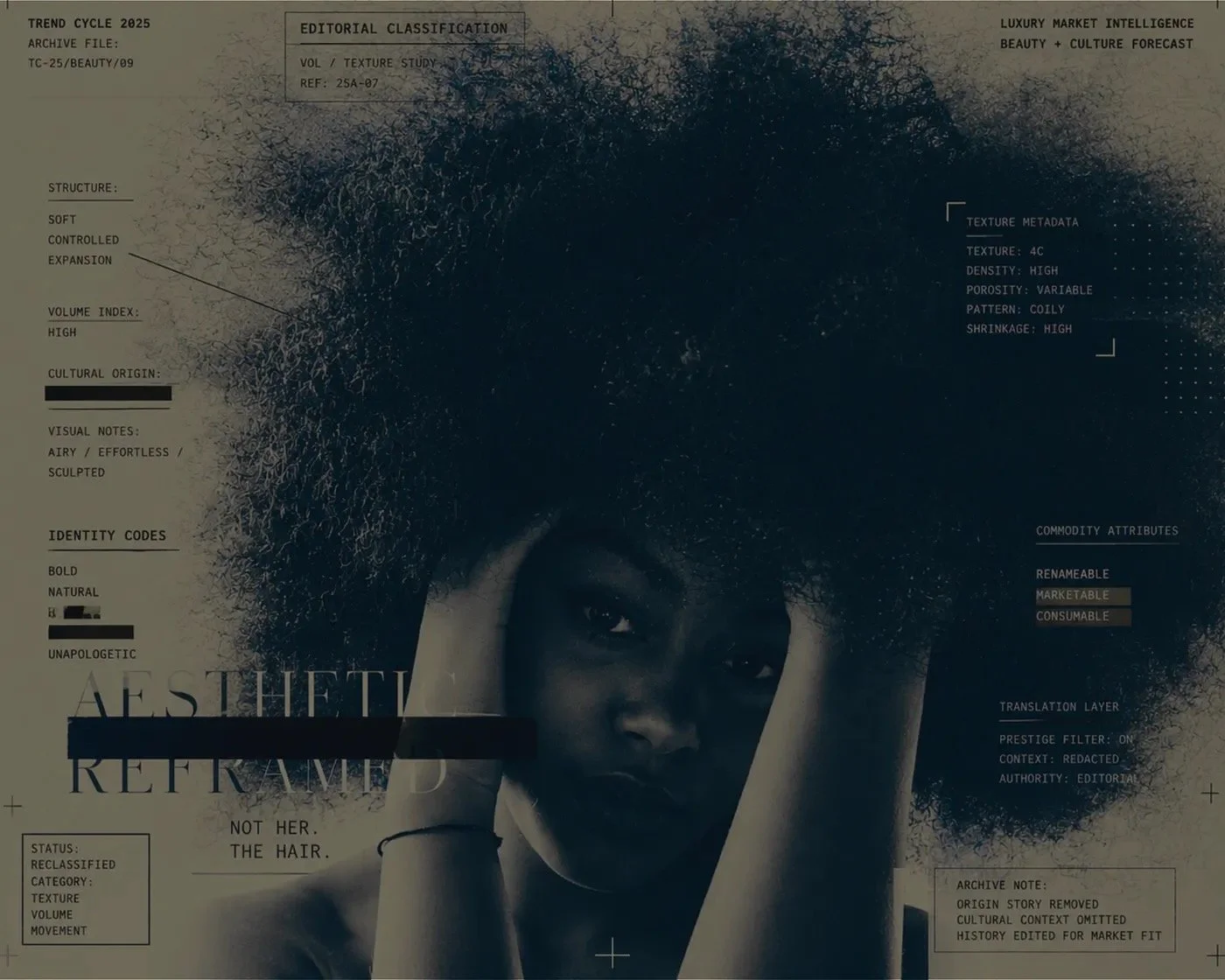
Visual Composition and Editorial Direction: Tanya Hill
There is something deeply American about needing federal legislation to protect Black women from discrimination over their natural hair while simultaneously watching luxury media rediscover that same hair as trend material.
One system calls it unprofessional. Another calls it editorial. One requires legal protection. The other requires a stylist quote, soft lighting, and a renamed aesthetic.
This is what made the “cloud bob” backlash land where it did.
And this is absurd.
I ruminated on this act. This encroachment. This hubris.
As a Black woman, and as someone formally trained in luxury ecosystems, I wanted to sit with my feelings around this.
The initial shock.
Then, the “what the @#%@” moment.
Then the “let me break this down in a way that makes sense to me” moment.
Because it was obvious, there were no individuals in the rooms at Vogue to push back on the “creative” direction.
Black women were not confused by this. We were not even that surprised. We knew what we were looking at. We recognized the visual language immediately. So, for me, the issue was never recognition. The issue was authorship.
When Vogue described a rounded natural hairstyle that included “4C coil” texture, through the newly branded language of the “cloud bob,” many readers saw something else entirely: a familiar cultural pattern in which Black aesthetics become more institutionally valuable once they are translated into the language of prestige.
And that pattern carries a particular kind of insult because Black women have spent decades navigating the opposite reality.
The same natural textures now recirculating through luxury beauty language have historically triggered workplace discrimination, school punishment, military restrictions, and professional policing.
The CROWN Act did not emerge because natural Black hair was universally understood as stylish, expressive, or worthy of celebration. It emerged because Black people repeatedly faced consequences for wearing their hair in its natural state.
And this contradiction matters. Because it reveals the difference between cultural creation and institutional validation.
Black women did not suddenly invent textured volume after fashion media found softer language for it. The aesthetic already existed. The cultural history already existed. The social penalties already existed too.
What changed was the audience. More specifically: the audience deemed valuable enough for luxury editorial translation.
That is why reducing this moment to “Vogue renamed an Afro” misses the deeper mechanism underneath it. This is not simply about mislabeling. It is about naming power.
Who gets to formalize culture once it becomes commercially desirable?
Who gets credited with discovery once aesthetics cross into prestige spaces?
And who absorbs the erasure when institutions decide novelty matters more than historical memory?
Fashion and beauty media do not merely report trends. They manufacture cultural legitimacy through naming.
Trend forecasting, celebrity styling, editorial language, search optimization, beauty commerce, and publication authority work together as a soft power system.
Once a major institution assigns new language to an existing aesthetic, that language enters search results, marketing copy, retailer categories, social media captions, and future editorial references.
The naming becomes infrastructure.
Many Black women are intimately familiar with the experience of watching something tied to their identity become more socially acceptable once detached from the people historically associated with it and the cultural burden attached to it.
Luxury culture often performs this translation quietly.
Blackness is softened into trend language. Historical context disappears behind words like airy, effortless, sculpted, undone, modern, or chic. Aesthetic elements that once carried racialized stigma become newly legible once filtered through prestige framing.
What prestige institutions want is not Blackness itself, but Black aesthetics stripped of the historical discrimination assigned to Black people.
So let’s be honest, this is not admiration. This is institutional laundering. Because admiration without acknowledgment easily becomes extraction, and extraction becomes difficult to challenge when the culture itself does not fit neatly inside traditional ownership systems.
What makes this conversation more complicated than a simple accusation of appropriation is that Black cultural aesthetics often exist outside the logic Western intellectual property systems were designed to recognize.
Traditional IP law tends to reward things that are individually authored, fixed, novel, and commercially distinct. A patented formula. A trademarked logo. A copyrighted work with identifiable authorship.
But culture rarely behaves that neatly.
The culture within which the “Afro” resides is not legally ownable in the traditional sense. But it can still be editorially controlled. That distinction matters more than many institutions are willing to admit. Because editorial authority shapes public memory.
Even the reported removal or editing of the “cloud bob” reference becomes part of the story. Digital media institutions now possess the ability not only to publish cultural narratives, but to quietly revise them. Correction without acknowledgment often protects institutional credibility more effectively than transparency does.
The act is removed, but the institution moves on.
And we, the audience, are left debating whether the thing happened the way we remember it happening at all. The harm is done. But the memory is erased.
But there is a deeper insult underneath moments like this: the implication that culture only becomes visible after institutions rename it.
The Afro was never waiting for editorial permission to exist. The institution was waiting for the right conditions to narrate it differently.
