The Real Fight Isn’t About Blush
It’s about what happens when a cultural signal becomes a commercial asset.
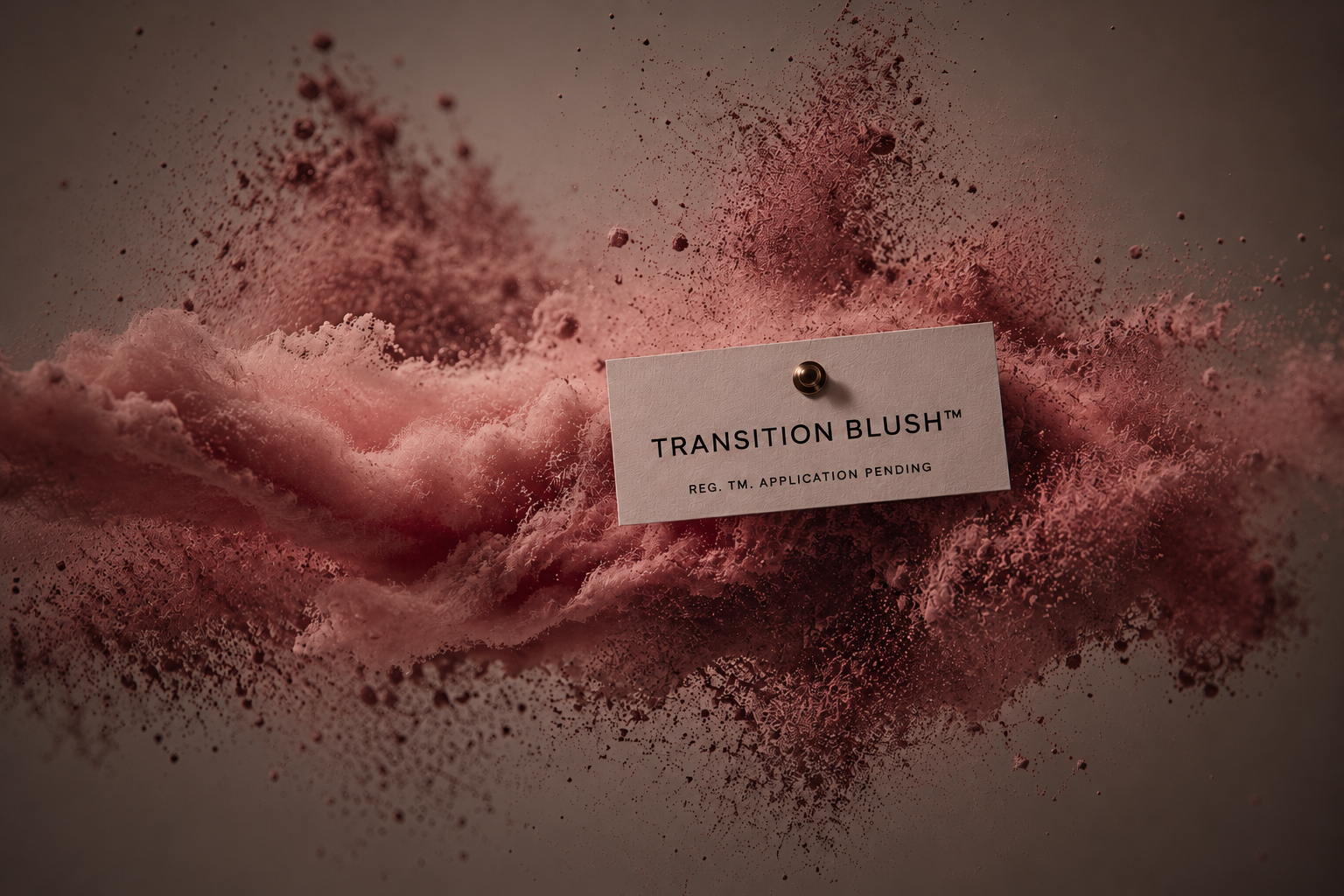
Visual Composition and Editorial Direction: Tanya Hill
Unless you have been actively avoiding beauty news, you have probably encountered some version of the Transition Blush controversy:
1. The controversy’s focus was Patrick Ta Beauty’s Transition Blush collection which launched at the end of May on his website and in Sephora stores;
2. A trademark application filed by Patrick Ta Beauty to register the phrase “Transition Blush”;
3. A growing chorus of enthusiasts asking whether a blush technique strongly associated with makeup artist Ngozi Esther Edeme was being commercialized without meaningful recognition.
On the surface, it looked like another internet fight about credit and who was taking whose side. Another creator-versus-creator dispute. And another cycle of social media trying to determine who did what first. However, this conversation began to extend beyond beauty enthusiasts, consumers and Painted by Esther supporters.
Beauty historians, beauty professionals, industry publications and beauty-focused brands entered the conversation and pointed to earlier influences including blush draping, gradient blush techniques, Asian beauty practices and Way Bandy. Even Kevyn Aucoin Beauty publicly acknowledged the technique’s historical lineage while recognizing Esther’s influence. MAC Cosmetics also featured Esther’s work in editorial content shortly after this controversy exploded.
This is where I became intrigued with this story as it continued to unfold. There was a framing of this controversy that was being missed and quite frankly the part that I found even more interesting. But first it was imperative that I understand the history not only of the technique but also the individuals involved in the ever-expanding debate.
I initiated my research with a focus on Painted by Esther.
So, who is Painted by Esther?
Ngozi Esther Edeme, known professionally as Painted by Esther, is a Nigerian-born, London-based makeup artist who began experimenting with makeup as a teenager. Esther attended university in the UK, where she originally trained as an artist and painter, before transitioning into makeup artistry and building her beauty portfolio. She became known for creating looks primarily on dark-skinned women and shared her creations online.
She identified early on in her career the recurring challenge within the blush category that had been surfaced repeatedly by publications such as Allure, Essence, and Who What Wear which was many blush formulas lacked sufficient pigmentation for deeper skin tones, appeared ashy, or were rarely demonstrated on darker complexions in mainstream beauty education. She helped demonstrate what blush could look like when deeper skin tones were treated as the starting point rather than the exception.
Her professional career began to accelerate around 2018 after touring with broadcaster and DJ Tiffany Calver. This led to editorial, fashion, and celebrity work for clients including Naomi Campbell, SZA, Kelly Rowland, Adut Akech and most recently Olandria Carthen the breakout star of the reality television show Love Island USA. Olandria has become the most visible canvas for Painted by Esther’s blush artistry. This relationship has evolved into formal brand partnerships, including a 2026 MAC Cosmetics collaboration with Painted by Esther centered on blush. More than a marketing campaign, the partnership reflects how cultural signals often travel: a creator develops a visual language, an audience embraces it, and eventually a recognizable figure emerges as its most visible embodiment. By that point, the aesthetic is no longer simply a technique. It has become a cultural identifier.
Therefore, for me, the underlying question is not who invented “transition blush.” It is “what happens when someone refines an existing technique, makes it culturally significant, commercially desirable, and visually legible to millions of people?” Then a larger institution arrives at the moment that significance becomes commercially viable. Painted by Esther was instrumental in making the technique culturally legible. Patrick Ta’s trademark application raises the question of who gets to make the legibility commercially official. And these developments are fueling broader conversations about attribution, commercialization, and cultural influence within the beauty industry.
So, who is Patrick Ta?
Patrick Ta did not emerge from the beauty industry as an institution. He emerged as a working makeup artist. Born and raised in Arizona, Ta initially built his career through client work before relocating to Los Angeles, where he entered an ecosystem that increasingly rewarded visibility, celebrity proximity, and digital influence. His rise coincided with the growth of Instagram-era beauty culture, a period during which makeup artists were no longer operating solely behind the scenes but were becoming brands in their own right. Through work with high-profile clients including Gigi Hadid, Shay Mitchell, Olivia Munn, and members of the Kardashian-Jenner family, Ta developed both a recognizable aesthetic and a growing public profile.
That visibility eventually evolved into something larger. In 2019, Ta partnered with beauty executive Rima Minasyan to launch Patrick Ta Beauty through Sephora. What began as the career of a makeup artist expanded into a vertically integrated beauty business with retail distribution, product development capabilities, legal infrastructure, brand strategy, and institutional resources.
This distinction matters because the current controversy is not occurring between two makeup artists operating from equivalent positions. It is unfolding between a creator whose influence helped shape a culturally significant aesthetic and a beauty company with the resources to formalize ownership through commercial and legal systems.
Understanding this history makes the current debate less about a single product launch and more about how cultural influence, market recognition, and formal ownership intersect when an underserved category becomes commercially valuable.
And this is my sweet spot because analyzing stories like this one is a natural extension of how I move through the world. My inquisitive nature and observation skills were shaped early, growing up in a family where achievement, intellectual curiosity, and critical thinking were not exceptions but expectations. Those instincts were further refined through more than two decades of work across law firms, in-house legal departments, private wealth, economic development, and intellectual property environments, alongside extensive experience in brand governance and institutional identity. Together, they have trained me to look beyond surface narratives and pay attention to the systems, structures, and ownership dynamics operating underneath them.
Therefore, understanding Patrick Ta’s evolution from artist to institution provides the context for why the trademark application filed with the United States Patent and Trademark Office (USPTO) by Patrick Ta Beauty generated so much scrutiny and essentially elevated the debate to more than just about blush. It is about who possesses the ability to transform cultural significance into a formal business asset.
However, one of the issues with viewing cultural authorship through a strict IP lens is that the questions: Who thought of it first? Who did it first? Who can prove ownership? do not tell the whole story. Because culture rarely works this neatly. Most techniques, aesthetics, traditions, and visual languages emerge through layers of influence, reinterpretation, adaptation, and refinement. They travel across decades, communities, industries, and geographies before becoming recognizable enough to acquire a name.
The Transition Blush technique is no exception. As noted above, the history of blush draping, gradient blush techniques, and Asian beauty influences clearly shows that the technique existed before Esther and Patrick Ta. Therefore, the technique existed before this newer phrase. And this is an important distinction. Because what is truly being contested here is not ownership of a makeup technique itself. It’s naming this technique.
A technique can exist for decades. But once it acquires a name, the technique becomes identifiable. Searchable. Marketable. Categorized. A phrase transforms a practice into a concept and concepts can be packaged, merchandised and organized into product lines and retail categories. And what Patrick Ta appears to be pursuing is ownership of the commercial language surrounding the technique. The power to name is the power to define the commercial territory surrounding the idea. And the name becomes the mechanism that fosters market understanding. This level of ownership shifts the power dynamics.
The strongest insight emerging from this controversy may be that we continue to treat ownership as though it is a single thing. It isn’t. There are at least three different forms of ownership operating simultaneously.
Cultural Ownership
· Who shaped the meaning?
· Who made people associate the idea with a particular aesthetic, community, or identity?
· Who influenced how the public understands it?
Economic Ownership
· Who profits when the idea becomes valuable?
· Who has access to manufacturing, retail distribution, partnerships, and scale?
Legal Ownership
· Who possesses enforceable rights?
· Who can file applications, secure protections, and build defensible commercial territory?
These three types of owners are not necessarily the same person. And this is why controversies like this feel bigger than the products involved. The frustration that many creators may feel is not always about legal rights. It is more about whether contribution, recognition, and reward remain connected. Or whether they drift apart once commercial value enters the picture.
This is why the current conversations surrounding these two creatives transcend the beauty industry. It resurfaces the knowledge that visibility and ownership are not equally compensated. Influence and compensation are not the same thing. Recognition and control are not the same thing. Essentially, culture is public, but ownership is filed privately.
Who owns transition blush? Is not the primary question.
The deeper question is: What happens when cultural value is created publicly, but ownership systems activate quietly? This question reaches far beyond makeup counters and Sephora shelves.
The Patrick Ta and Painted by Esther controversy is unlikely to be the last example. If anything, it may be an early illustration of a much larger shift. Because culture is now developing faster than our systems for recognizing contribution. And until those systems evolve, we will continue to encounter the same tension in different forms:
The people who make something visible are not always the people who get to name it. And the people who get to name it often become the people history remembers.
